
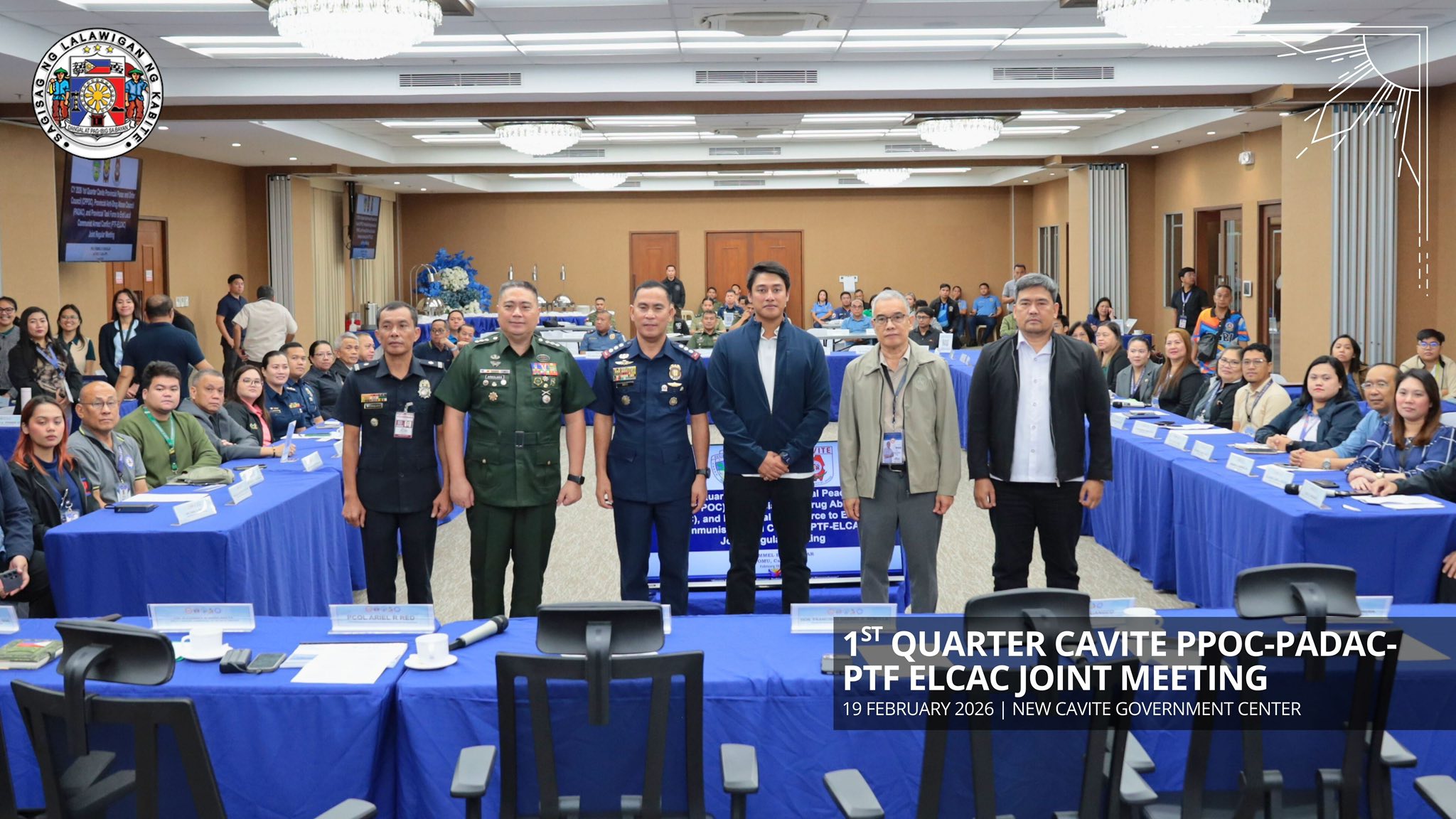
Government leaders and security stakeholders convened at the New Cavite Government Center, Trece Martires City on February 19 for the first quarter joint meeting of the Cavite Provincial Peace and Order Council, Provincial Anti-Drug Abuse Council, and Provincial Task Force to End Local Communist Armed Conflict, underscoring a unified push to strengthen peace and public safety across the province.
Governor Francisco Gabriel D. Remulla presided over the session, which highlighted interagency coordination, legislative support, and community-based strategies to address criminality, illegal drugs, insurgency, and other security concerns.
Among the key agenda items was the presentation of the CY 2025 Peace and Order and Public Safety (POPS) Plan accomplishment report, covering physical and financial gains from the first to fourth quarters. Updates were also delivered by law enforcement and anti-drug units on crime trends, barangay drug-clearing operations, and ongoing campaigns against illegal narcotics.
The 202nd Infantry Brigade of the Philippine Army provided a security briefing on anti-insurgency efforts, while social welfare officials reported on programs supporting former rebels under the Enhanced Comprehensive Local Integration Program (ECLIP).
Fire safety and disaster readiness were likewise tackled, with the Bureau of Fire Protection presenting measures to strengthen emergency response and public safety compliance.
The council also heard updates from civil society partners and the joint secretariat, reflecting a whole-of-government and whole-of-society approach to peacebuilding.
In the afternoon session, members deliberated on proposed resolutions, including the declaration of certain individuals involved in New People’s Army “tour of duty” activities as persona non grata in the province, the inclusion of the National Police Commission in the Provincial Peace and Order Council, and the creation of a special action committee for the protection and inclusion of refugees, asylum seekers, and stateless persons.
Officials emphasized that harmonized policies, intelligence sharing, and grassroots engagement remain critical in addressing evolving security challenges. The joint council reaffirmed its commitment to sustained collaboration among government agencies, local government units, and community stakeholders to ensure a safer and more resilient Cavite. — A. Sarte